Grove CEPrimary School
Music
Revised 2026
“Music multiplies all that is beautiful and of value in life.”
Kodaly
Intent
The intent of our Music curriculum is to ensure children have access to a rich range of musical activities, both in and out of lesson time, in which all are able to achieve. Our curriculum develops children’s knowledge, skills and enjoyment so that they understand, know and create music in meaningful ways and in a range of situations.
By engaging with high‑quality, sequenced lessons from Oak National Academy, alongside practical music‑making in school, children will:
-
Develop listening skills that enable them to retrieve examples of their learning and build musical vocabulary. This includes exposure to a wide range of genres, cultures and historical periods.
-
Learn to sing confidently in a variety of styles, using their voices effectively and expressively.
-
Use their knowledge of rhythm and pitch to improvise phrases within given scenarios.
-
Explore structure and timbre to create effective pieces that reflect their understanding of melody, rhythm and accompaniment.
-
Record and read their own musical ideas and those of others using written symbols and technology.
Our curriculum map outlines the intended learning across the school, ensuring progression in subject knowledge, musicianship and enjoyment. The integration of Oak National Academy provides a consistent, high‑quality foundation while allowing teachers to enrich learning with school‑based performance, instrumental work and wider musical experiences.
Implementation
We teach the National Curriculum and the EYFS framework, supported by clear skills and knowledge progression. Oak National Academy’s Music curriculum forms the core sequence of learning across the school. This ensures that skills and knowledge are built year by year and sequenced appropriately to maximise learning for all children.
How Oak National Academy is used
-
Each year group follows the relevant Oak National Academy units as the primary teaching sequence, ensuring high‑quality, specialist‑designed lessons.
-
Teachers adapt and supplement Oak lessons with:
-
Additional practical work using tuned and untuned instruments.
-
Opportunities for improvisation, composition and performance.
-
Cross‑curricular links where appropriate.
-
School‑specific events, celebrations and performance opportunities.
-
Classroom Practice
From the long‑term overview, teachers use Oak’s structured lesson sequences to deliver core knowledge and skills. These are enhanced with school‑based activities such as:
-
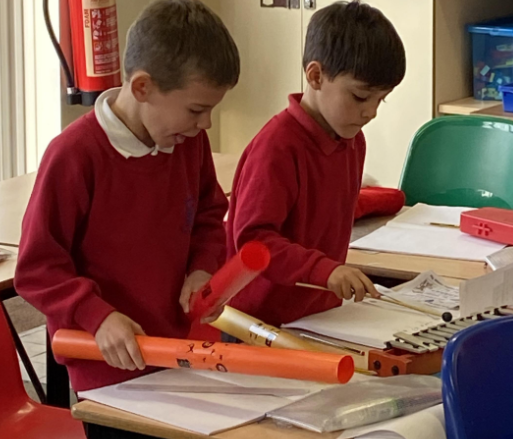
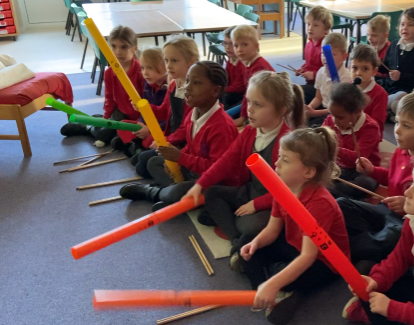
Whole‑class instrumental work (e.g., glockenspiels, percussion).
-
Singing practice linked to collective worship and school events.
-
Composition tasks using classroom instruments and digital tools.
-
Listening and appraisal activities that broaden cultural and historical understanding.
Wider Musical Opportunities
We provide a range of opportunities for children to develop individually as musicians, including:
-
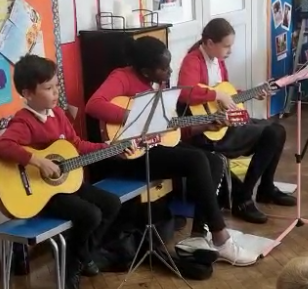
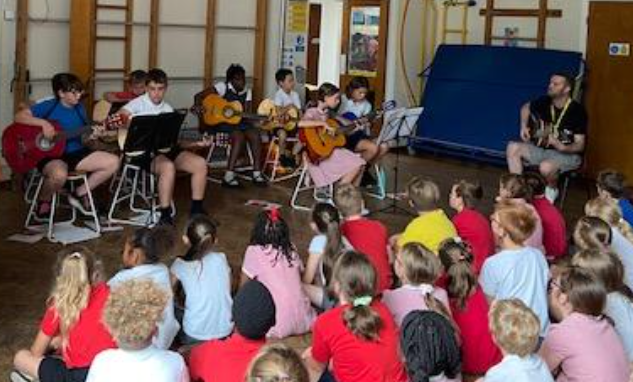
Peripatetic instrumental lessons including drums, piano and guitar.
-
Regular whole school enrichments events such as Rock Kidz and Bassistry.
-
Performances in concerts, plays and assemblies.
Impact
By the time children leave our school, they will have developed the ability to:
-
Sing with confidence and expression, demonstrating control of phrasing, pitch and breathing.
-
Use a range of tuned and untuned instruments to create musical effects for different purposes, showing understanding of timbre.
-
Compose their own music individually and collaboratively, using increasingly adventurous structures and a variety of musical techniques.
-
Understand essential music theory, including notation and how chords are structured and used.
-
Read and write music using a variety of notations, including staff notation.
-
Identify key musical features of pieces and genres from a range of composers, cultures and traditions.
-
Discuss music using appropriate musical vocabulary and concepts.